
EV & Smart Home
EV Charger Installation
A dedicated Level 2 circuit sized for the car you have and the one after it.
EV Charger Installation — what's involved
A Level 2 charger is a dedicated 240-volt circuit with a substantial continuous load on the end of it, and that is the part worth getting right. Continuous loads are sized at 125 percent of their rating, so a 48-amp charger needs a 60-amp circuit — not a spare slot and a hope. The first question on every EV charger job is not which unit to buy, it is whether your service can carry it, and that is answered with a load calculation rather than a guess.
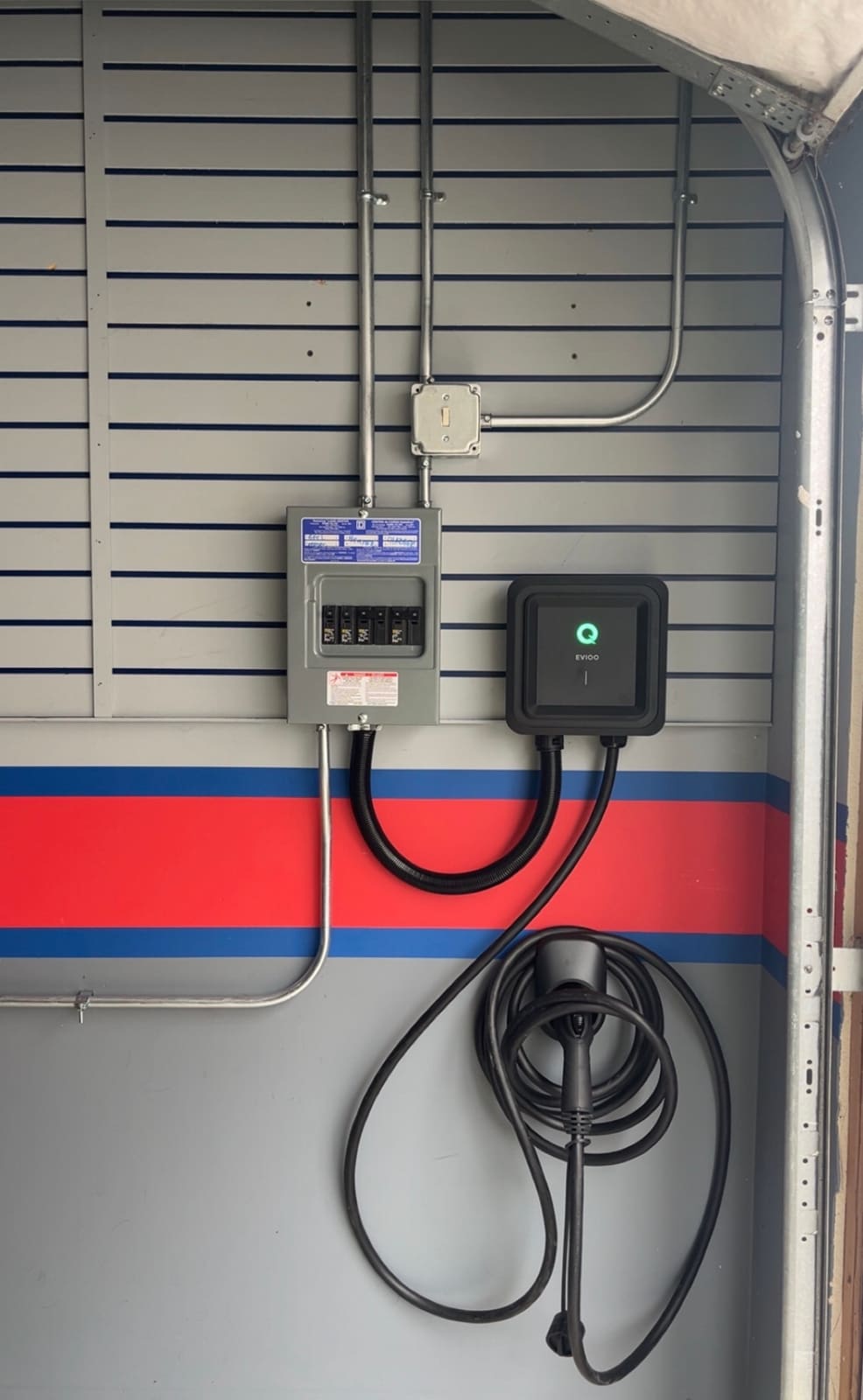
The installation photographed above is a typical good outcome: a wall-mounted unit in the garage fed from a compact sub-panel, with the run in neatly bent metal conduit and the cable coiled on its holster rather than pooled on the floor. Electric Shock handles the whole sequence — load calculation, circuit, any panel or service work it depends on, mounting, and commissioning the unit on your network.
EV charging work
- Load calculation to confirm what your existing service can actually support
- Dedicated 240V circuits, commonly 40A or 60A, sized to the charger's continuous rating
- Hardwired units and NEMA 14-50 / 6-50 receptacle installations
- Garage sub-panels where the main panel is full or a long way from the parking spot
- Load management devices that let a charger share capacity on a constrained service
- Outdoor, carport and detached-garage installations in wet-rated equipment
- Conduit runs, mounting, commissioning and connection to the unit's app or network
- Provision for a second charger, roughed in now for a second vehicle later
The EV Charger Installation process
Run the load calculation
We total your existing service load and add the charger as a continuous load. This tells us immediately whether you need a straightforward circuit, a load management device, or a service upgrade first.
Settle the location
Where the car parks, which side its port is on, and whether you will ever park a second vehicle there. Cable length is fixed once the unit is on the wall, so this is worth five minutes.
Decide hardwired or plug-in
Hardwiring is required above 48 amps and is generally tidier and more reliable outdoors. A receptacle keeps the unit portable and easier to replace. Both are legitimate and we will explain the trade-off for your situation.
Install the circuit
Dedicated breaker, correctly sized conductors, conduit or cable appropriate to the route, and GFCI protection where the installation method requires it.
Mount, commission and test
Unit mounted at a sensible height, connected to your network if it has one, and tested through a real charging session before we leave.
What you get out of it
Charging speed that is actually useful
Level 2 turns overnight charging from partial into complete, which is the practical difference between planning around the car and not thinking about it.
Sized for the next car too
Running conductors for 60 amps while the wall is open costs very little more than 40 and saves the whole job being redone.
No surprise service upgrade
The load calculation happens before you buy anything, so you find out what is involved at the quoting stage.
EV Chargers questions
Still not sure? Send us the details and we'll give you a straight answer before anything is booked.
Can my panel handle an EV charger?
What amperage should I install?
Hardwired or a 14-50 receptacle?
Do you install chargers in detached garages and carports?
Often booked alongside this
- Electrical Panel UpgradesSwap a crowded, fused or obsolete panel for a modern breaker panel with room to grow.
- Sub-Panel InstallationFeed a garage, addition, shop or basement from its own sub-panel instead of a dozen long home runs.
- Smart Home WiringStructured cabling, smart switching and the neutral conductors smart devices need.
Need EV Charger Installation?
Tell us about the property and what you're trying to achieve. Quotes are free and there's no obligation.
Start with a free quote
Pick EV Charger Installation from the service list below and tell us what you need. Photographs of the panel, the room or the equipment help us answer far more precisely.