Residential & General Electrical
Service & Meter Upgrades
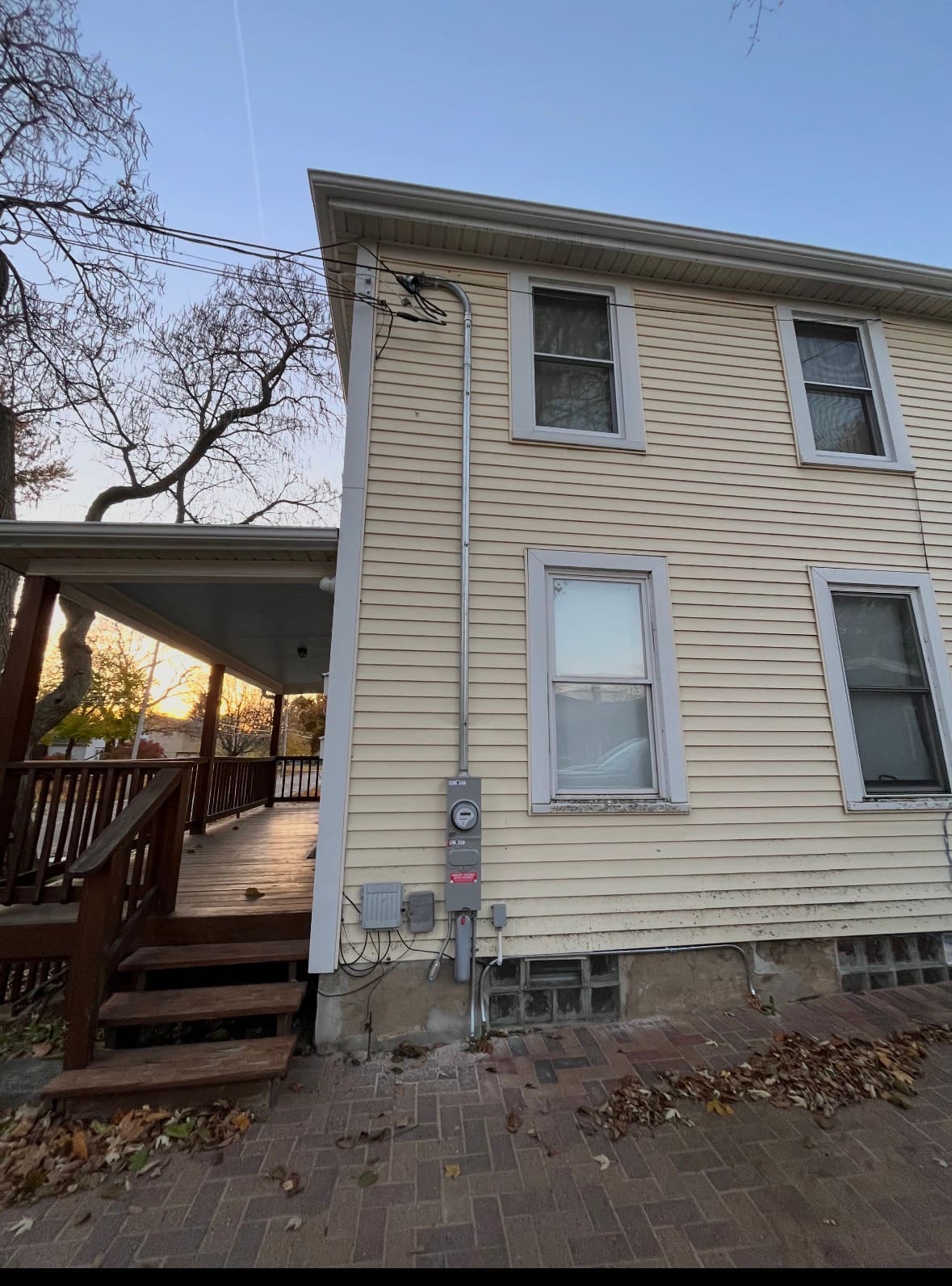
The mast, riser, meter socket and service entrance — the half of the upgrade that lives outside.
Service & Meter Upgrades — what's involved
Everything between the utility's wires and your meter is service equipment, and it takes the weather. Masts rust and loosen at the roof penetration, weatherheads crack, insulation on service entrance conductors goes brittle and splits, and meter sockets corrode or burn at the lugs. A panel upgrade inside the house frequently means the service equipment outside has to be replaced to match — a 200-amp panel fed by a 100-amp service entrance is still a 100-amp service.
Electric Shock handles the outdoor half of the job: masts and risers, weatherheads, service entrance conductors, meter sockets, and the exterior disconnect where one is required. Because this equipment is owned partly by you and partly by the utility, the work is sequenced around a utility disconnect and an inspection, and we coordinate both.
Service equipment we replace
- Service masts and risers, including re-flashing and re-anchoring the roof penetration
- Weatherheads and service entrance conductors that have split, cracked or corroded
- Meter sockets, including burned or corroded lug terminations
- Exterior service disconnects where the jurisdiction requires one
- Overhead-to-underground conversions and re-routes around additions or new construction
- Grounding electrode conductors and ground rods at the service
The Service & Meter Upgrades process
Survey the service entrance
We inspect the mast, weatherhead, conductors, meter socket and grounding, and check the attachment point and clearances over walkways, driveways and rooflines against current requirements.
Confirm ownership and scope
The utility owns the drop up to its attachment; you own the mast, riser, meter socket and everything inward. We establish where that line falls on your property so there is no surprise about who does what.
Schedule the disconnect
The utility disconnects the drop, and the permit is in place before that happens. Most residential service changes are a same-day disconnect and reconnect.
Replace and re-seal
New mast, riser, weatherhead, conductors and meter socket go in, with the roof or wall penetration properly flashed and sealed — a service mast is a hole in your building envelope as much as it is an electrical component.
Inspect and reconnect
The inspector signs off, the utility re-terminates the drop, and the meter goes back in.
What you get out of it
Weather-tight where it matters
A properly flashed mast and a sealed weatherhead keep water out of the riser and out of the wall behind it.
Capacity that actually matches the panel
Upsizing the service entrance is what makes a 200-amp panel a 200-amp service rather than a 200-amp enclosure.
Corrosion caught before failure
Burned meter lugs and brittle conductors fail suddenly and at the worst time. Replacing them is planned work rather than an outage.
Service & Meter Upgrades questions
Still not sure? Send us the details and we'll give you a straight answer before anything is booked.
What is a service mast, exactly?
Do I need this if I am only upgrading the panel?
Who contacts the utility — me or you?
Often booked alongside this
- Electrical Panel UpgradesSwap a crowded, fused or obsolete panel for a modern breaker panel with room to grow.
- Electrical Safety InspectionsWritten condition reports for home purchases, insurance, rentals and older properties.
- Sub-Panel InstallationFeed a garage, addition, shop or basement from its own sub-panel instead of a dozen long home runs.
Need Service & Meter Upgrades?
Tell us about the property and what you're trying to achieve. Quotes are free and there's no obligation.
Start with a free quote
Pick Service & Meter Upgrades from the service list below and tell us what you need. Photographs of the panel, the room or the equipment help us answer far more precisely.