
Lighting
LED & Cove Lighting
Concealed linear LED that lights the architecture instead of the room.
LED & Cove Lighting — what's involved
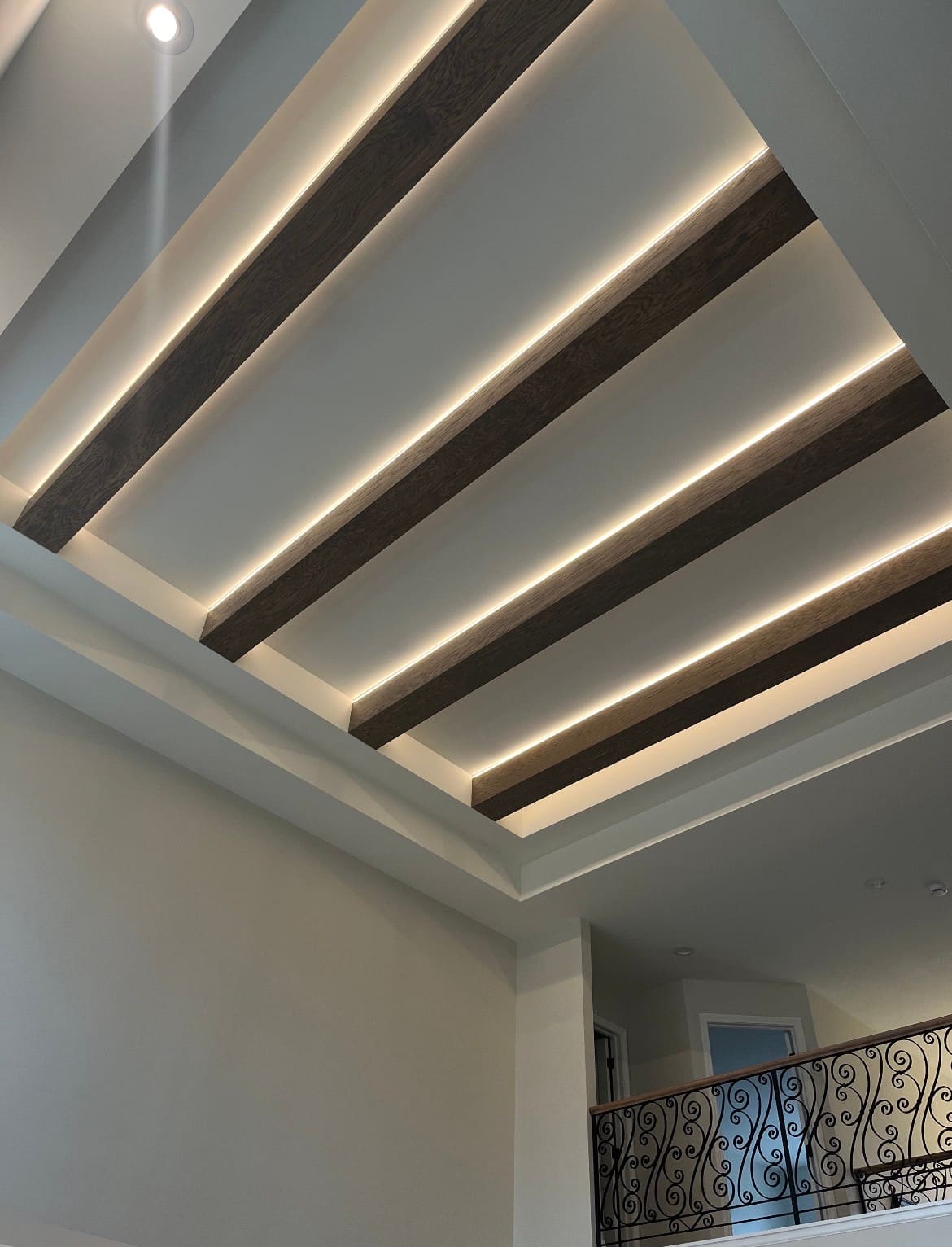
Cove lighting works by hiding the source. A linear LED run set into a recess throws light up and across a surface, and what you see is the lit plane rather than the fixture — which is why a coffered ceiling with cove lighting reads as architecture and a coffered ceiling with downlights in it reads as a ceiling with lights in it. The beam ceiling photographed above is that effect: warm LED tape concealed in the recess beside each beam, washing the panels between them.
Getting it right is mostly about things that are invisible in the finished result. The tape has to sit far enough back that the individual diodes cannot be seen from any normal viewing angle, the driver has to be sized with headroom and located somewhere accessible, and the dimming has to be matched or the whole run shimmers. Electric Shock coordinates this with the carpenter or drywall contractor while the detail is still being built, because the recess dimension is the one thing that cannot be changed afterwards.
Concealed and linear LED work
- Cove, tray, coffered and soffit lighting in ceilings and around bulkheads
- LED tape in aluminum channel with diffusers, which removes the dotted appearance
- Correctly sized drivers with headroom, located where they can be serviced
- Tunable white and color-changing runs where the room justifies it
- Stair, handrail, toe-kick and niche lighting
- Exterior soffit and architectural linear lighting in wet-rated channel
- Replacing failed or mismatched sections of existing tape runs
The LED & Cove Lighting process
Design the detail with the trades
Recess depth, the lip height that conceals the source, and the distance from tape to the lit surface all determine the result. We work these out with whoever is building the detail, before it is built.
Specify tape and channel together
Density, output, color temperature and CRI, in channel with a diffuser. High-density tape and a diffuser are what prevent the run reading as a line of dots.
Place drivers where they can be reached
Drivers are the component most likely to need replacing. Putting them behind a sealed ceiling to save an access panel is a decision someone regrets later.
Install with correct feeds
Runs are fed at the right intervals to avoid voltage drop along the tape, which is what causes one end of a long run to sit visibly dimmer than the other.
Commission at night
The run is dimmed through its full range and viewed from where people will actually stand, to confirm no source is visible and no flicker appears at the low end.
What you get out of it
Light without a visible fixture
Nothing to see on the ceiling, which is the entire appeal — and the reason it suits coffered and tray detailing so well.
Soft, indirect, and easy to be under
Bouncing light off a surface produces a diffuse wash with none of the glare of a direct source in your line of sight.
Built to be serviced
Accessible drivers and channel-mounted tape mean a failure in five years is a repair, not a demolition.
LED & Cove Lighting questions
Still not sure? Send us the details and we'll give you a straight answer before anything is booked.
Why does my existing LED strip look like a row of dots?
Can cove lighting be added to an existing ceiling?
Why does my strip flicker when dimmed?
Often booked alongside this
- Lighting Design & RemodelsWhole-room lighting plans for remodels — layers, switching, dimming and control zones.
- Recessed & Can LightingRecessed cans laid out properly and retrofitted into finished ceilings with minimal damage.
- Under-Cabinet LightingConcealed LED task lighting under wall cabinets, hardwired and properly switched.
Need LED & Cove Lighting?
Tell us about the property and what you're trying to achieve. Quotes are free and there's no obligation.
Start with a free quote
Pick LED & Cove Lighting from the service list below and tell us what you need. Photographs of the panel, the room or the equipment help us answer far more precisely.